IoT connectivity & sensing
Selecting the right network — LoRaWAN, cellular IoT, fiber or Wi-Fi — for each type of field device.
- Coverage and gateway planning
- Device onboarding and management
- Secure device credentials

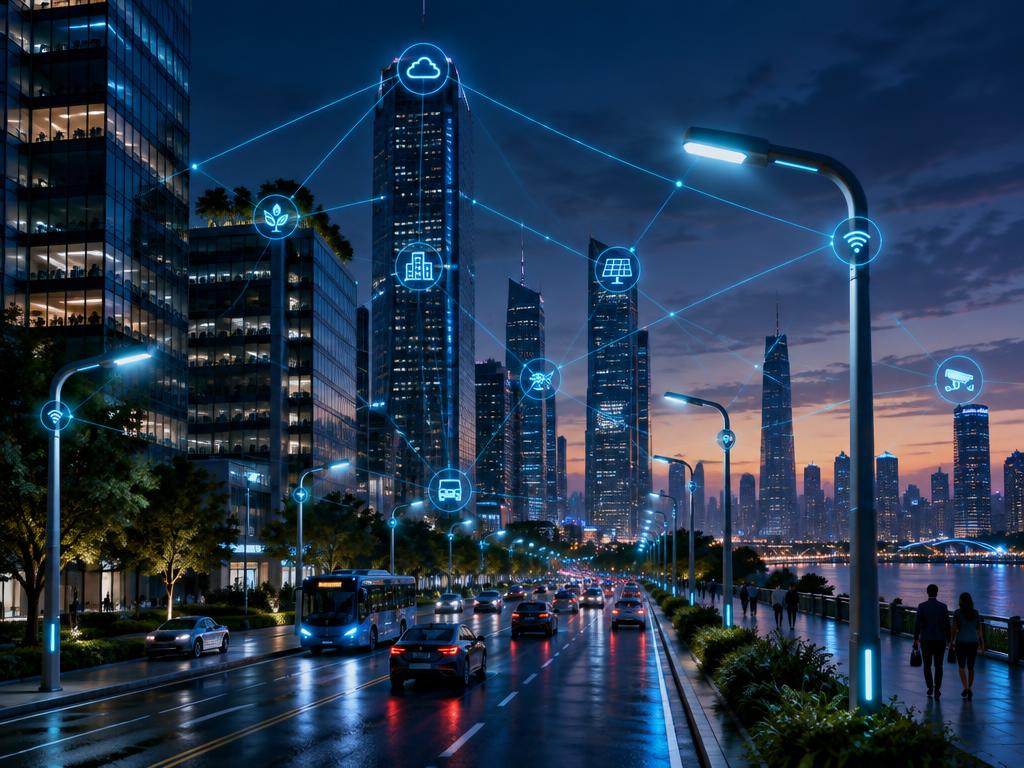
IoT platforms, smart lighting, environmental monitoring, mobility and parking, city data platforms.
We connect urban assets into a single data layer, giving city and development teams measurable visibility over mobility, lighting, utilities and the public environment.
Why it matters
Capabilities
Each layer can be delivered on its own, but they are designed to connect into one shared data platform.
Selecting the right network — LoRaWAN, cellular IoT, fiber or Wi-Fi — for each type of field device.
Networked street and area lighting with scheduling, dimming and fault reporting.
Air quality, noise and weather sensing to inform public-realm and operational decisions.
Parking occupancy, guidance and traffic data that reduce search time and congestion.
A shared data layer that normalises device data and exposes it to dashboards and other systems.
Bringing monitoring, sensor and alert data into a unified operational view to help teams track events, coordinate and respond through defined workflows.
TECHNOLOGY
Representative connectivity, sensing, infrastructure, cloud and analytics technologies relevant to smart-city solutions.
Representative technologies shown for capability illustration only. Inclusion does not imply a commercial relationship, endorsement, or affiliation with Smart Point.
 CiscoCisco
 HuaweiHuawei
 LoRaWANLoRaWAN
 MoxaMoxaCiscoCiscoHuaweiHuaweiLoRaWANLoRaWANMoxaMoxaCiscoCiscoHuaweiHuaweiLoRaWANLoRaWANMoxaMoxa
Use cases
Plan connectivity, lighting and sensing with the infrastructure so services are ready at handover.
Add central control and fault reporting to existing street lighting in phases.
Combine parking, environment and security data in one unified operational view.
Illustrative scenarios, not references to delivered projects.
Delivery approach
Final deliverables are agreed per project scope.
Tell us the area, the services you need and the systems already in place.
AI-driven video analytics, intelligent automation, machine vision, predictive insight and decision support integrated with operational systems.
Design, installation and integration of the low current systems modern facilities depend on — security, safety, communications and structured cabling — delivered as one coordinated platform.
Data centers, networking, servers, storage, virtualization, cloud, connectivity and enterprise infrastructure.